Even the Air Between You and the Screen Is Full of Collaboration

15 questions
Which part of your life needs restoration?
Could your trash be someone else’s treasure?
Repair or upcycle?
Could you manage your organization like a forest?
Does nature have the same stake as your investors and customers?
Why not?
Do you give yourself a break?
How do you nourish your body?
And your mind—and those of others?
Would your colleagues call you a regenerative leader?
Do you base your decisions on efficiency or longevity?
What do you expect, specifically, from COP26?
If you could live infinitely, like some trees, would you?
Stay on Earth or move to Mars?
When?
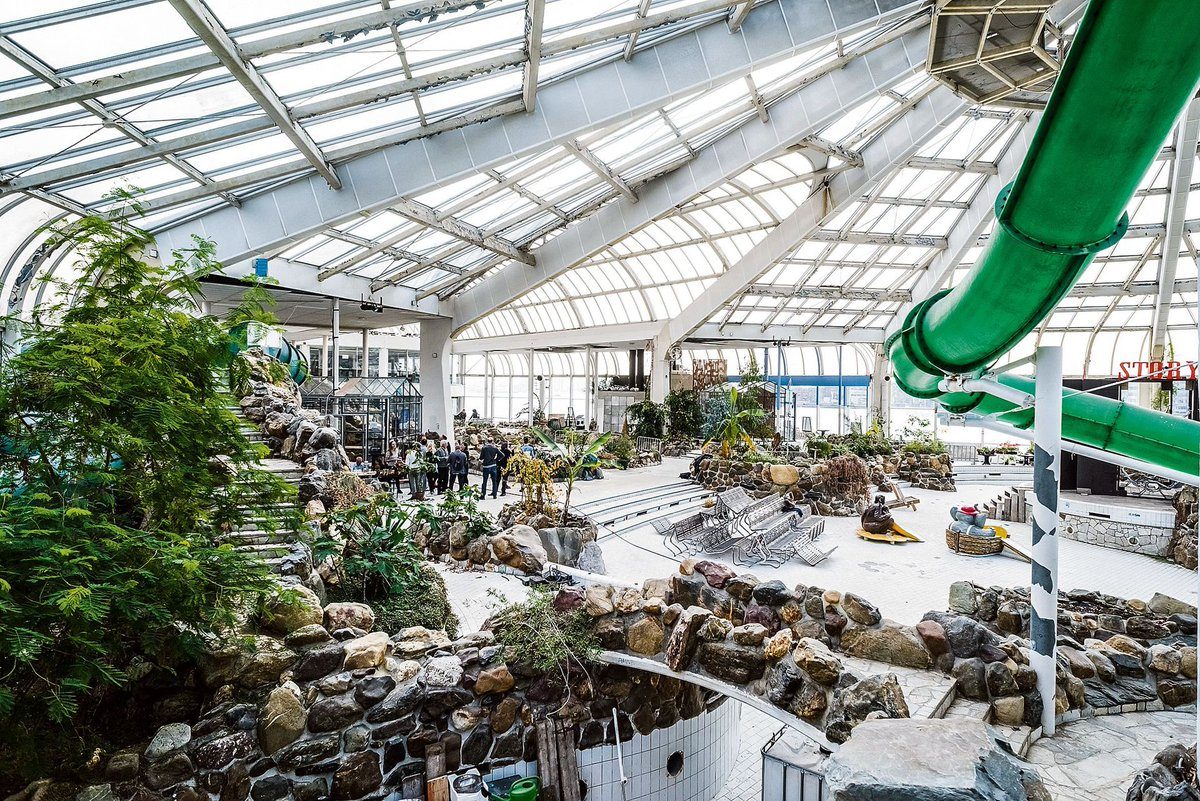
Rotterzwam: Growing mushrooms in an abandoned swimming pool in Rotterdam, The Netherlands
GM has committed to making 30 models of electric cars by 2025. SC Johnson promises to make 100 percent of its packaging recyclable, reusable, or compostable by the same year. P&G has pledged to source at least five billion liters of water from “circular sources.”
The future of business is “regenerative”—from the inside out, and outside in, beginning with concrete acts, affecting everything from marketing to supply chains, revenue streams to culture. Or, if it doesn’t, it might as well shut down. Simple as that.
“Regeneration” has two meanings: to form or create again, and to restore to a better, higher, or more worthy state. Making nature better than it was before we clear-cut forests or nearly doubled the amount of carbon in the air might be impossible. But restoration is vital, in the very essence of the word—“a manifestation of life.” We’ve had evidence of its necessity for years, actually, centuries, had we listened closer to Swedish scientist Svante Arrhenius, who foresaw what we now know as climate change in 1896 (nope, not a typo). By shifting from linear to circular, monocultural to (bio)diversity, and extraction to reciprocity, we might get away with saving our businesses and livelihoods.
Regenerative companies—in theory—decouple financial gain from the consumption of finite resources. They aim to produce without pollution (or at least cut down on how much pollution they generate), make products that last (or biodegrade quickly), and restore the planet’s resources.
But how does a regenerative business work? Examples abound: Interface, a maker of carpet tiles, pioneered a carbon-negative tile backing that uses direct-air carbon capture in its manufacturing process. Heavy-machinery maker Caterpillar has developed ways to remanufacture engine blocks, and encourages customers to return engine cores by charging a deposit. Berlin-based diaper manufacturer Dycle makes compostable diapers that foster parent communities around its collection sites. And the Dutch company Rotterzwam grows oyster mushrooms on used coffee grounds in an abandoned swimming pool—a stranded asset.
How does soil health factor into your marketing plan?
Organic farms skip the nitrogen-based fertilizers used in industrial farming that add huge amounts of CO2 to the atmosphere. But they still employ carbon-intensive practices like tilling that leave land vulnerable to erosion. Regenerative farming goes further. From the fashion industry to the produce stand, talk of sheep’s wool, cowhide, and tomatoes that are sourced in ways that restore the land and capture carbon is replacing “organic” as the new standard in social responsibility.
Instead of tilling, regenerative farms use cover crops to restore the soil, welcome animals like birds and cattle to graze (and to contribute their own natural fertilizers in the process), and leave the resulting cut vegetation undisturbed so that it turns to mulch, which prevents erosion, preserves nutrients, and keeps carbon in the soil and out of the air. (Last week, the amount of CO2 in the Earth’s atmosphere reached its highest level in 4.5 million years.)
Sales of products marketed as sustainable grew more than seven times faster than their conventional counterparts between 2015 and 2020. Products ranging from bison meat to beer are now sold under the regenerative label, and Danone, General Mills, and Pepsi have all pledged major investments in the practice.
But no legal definition of regenerative farming yet exists—which is certainly cause for skepticism. To address that, the Rodale Institute, Patagonia Provisions, and Dr. Bronner’s have partnered to form a certification program to create standards around the “regenerative” claim. Here’s hoping.
Institutional investors turn green
As Bill Gates explains in How to Avoid a Climate Disaster, clean solutions are often more expensive than high-emissions ones because the true economic and environmental costs of the polluting options aren’t factored into their price. So even though consumers are willing to pay a “green premium” for products that promise to do good, whether for the climate or their personal health, that premium itself is an obstacle to growth. Consumers won’t adopt zero-carbon options in numbers large enough to make real change as long as they cost more.
But maybe shareholders will. One promising development is the rise of shareholder pressure on companies like Exxon Mobil and Shell to reduce carbon emissions. As the Wall Street Journal puts it, the “development of climate change as a factor for investors to consider is shaking the investment world.” The Dutch organization Follow This has succeeded in leading shareholder rebellions at BP, Chevron, ConocoPhillips, and Phillips 66. “Institutional investors understand that no investment is safe in a global economy wracked by devastating climate change,” Follow This founder Mark Van Baal told The Guardian last month. To the business world: take note.
The “Methuselarity” is coming
Nature isn’t the only thing that can be restored. Aubrey de Grey, chief science officer and co-founder of the Sens Research Foundation—who will be joining us at our Concrete Love event later this year—is working to regenerate human beings at the cellular level. De Grey studies the cellular damage that contributes to mammalian aging, and works to develop interventions, including stem-cell therapies combined with “senolytic drugs,” to kill senescent cells.
The first human to live to the age of 1,000 years may already be alive, de Grey claims. He argues that there’s “a 50 percent chance that we will reach longevity escape velocity by 2036”—an event he terms the “Methuselarity”—after which “those who regularly receive the latest rejuvenation therapies will never suffer from age-related ill-health at any age.”
What will such regeneration efforts cost, one might ask? Will that be just for the rich? Not so, de Grey believes. The end user will pay nothing, because aging itself is so expensive that “it would be economically suicidal for any country not to make these things available, irrespective of ability to pay, to everybody who’s old enough to need them.” Also, keeping the elderly healthy and fit enough to contribute to the economy will mean the therapies “pay for themselves many times over really quickly.”

Photo by FOODISM: Burnt onion skins to make ash preventing food waste
A different quality of consciousness
We spoke to coach and author Giles Hutchins, author of, most recently, Regenerative Leadership, about how he perceived this growing demand for—and belief in—the power of regeneration. It’s an obvious and adaptive response to the stresses on our planet and psyches, he believes. He also believes that business is integral to the answer. “I purposely went into business. I would say I consciously chose business as a path because ‘business’ seemed to be the reason people were giving”—for our collective bad behavior, our grasping, breathless consumerism."
Working in management consulting for KPMG, with a 70-person team, worked for him for a while until it didn’t—and he found himself blurting out things like, “‘This is just ruining people in the organization’ or ‘This is destroying the resilience of the supply chain’—whatever it was at the time,” he recalled. “But it wasn’t making any sense to people. I had to try and meet people where they were at.” This prompted a personal and professional journey through building the business case for sustainability to the pivot point we are at now, says Hutchins. “It's not really about justifying the costs, or touting the benefits, of sustainability. It's much more about how we need a different quality of consciousness to lead in the times that we're living in.”
The quality of consciousness we need rests on a restored sense of connection to ourselves, to each other, and to life. It would be a mistake, he ventured, to view regeneration as something one can tack on to existing individualist paradigms. Fundamental to any kind of regeneration, regardless of the system one operates in, is an abiding conviction that life operates through interconnection:
“Facilitation ecology is a growing area that recognizes how nature is constantly inter-relating and collaborating. Now there’s competition, and competition is a healthy part of that, but there is also this innate capacity to engage and to share and to be open. So every cell in our bodies is permeable. Ninety percent of the cells in our bodies aren’t even human. We are a bundling, seething sea of collaboration, and that’s just our bodies. And the same with the air between you and the screen, it’s full of collaboration. It’s everywhere.”
And it’s intangible. Call it the field, as some do, or the quantum vacuum, as quantum physicists do, but for Hutchins it’s a source of hope, as it suggests the possibility that our individual enlightenment can affect the collective in ways that our “rational, reductive perspective” could scarcely comprehend.
Hutchins explored this at length in his book The Illusion of Separation. His book Regenerative Leadership is co-authored with Laura Strom. You can find more about Hutchins’s coaching work with individuals and companies on his blog.

Photo by USGS: Green farmland between the Nile floodplain and the surrounding desert
Burnt out no more
In 2019 the World Health Organization added burnout to its International Classification of Diseases, noting that it’s “a syndrome conceptualized as resulting from chronic workplace stress that has not been successfully managed.”
Burnout is said to have six main causes:
Unsustainable workload
Perceived lack of control
Insufficient rewards for effort
Lack of a supportive community
Lack of fairness
Mismatched values and skills
Jennifer Moss writes in Harvard Business Review that the causes of burnout are all organizational, but the cure most often proposed is changes in personal care—not changes to work structures. Tony Schwartz, CEO and founder of consulting and training company The Energy Project, puts the onus on leadership:
“Leadership burnout begets employee burnout. How often do you or other leaders in your company send out emails late into the evenings and over weekends? To what extent do leaders at your company expect people to respond to emails and join conference calls even when they’re on vacation? How many of your leaders role-model a balanced life and actively support others in taking care of themselves?”
Schwartz and his team surveyed 20,000 employees. Only a quarter stated that their leaders exhibited healthy, sustainable work behavior. The lucky ones who worked under these leaders were “55 percent more engaged, 77 percent more satisfied at work, and 1.1 times more likely to stay at the company. They also reported more than twice the level of trust in their leader.”
Unless you’re one of those lucky ones, self-care may be the only option—apart from finding a new job.
Ps.
In the beginning there were bacteria, algae, lichens, herbs and shrubs.
Life comes from below.
But what is below always has the sky above.
As in an endless cycle, our cooperative work returns to the tree, regenerating it.
Life, death, new life.
We are food for each other.
And we regenerate.
Even the least treated waste can sometimes be surprising.
Life is strange.
Let’s think about the present and invent queer projects for the future.
The past is always rotten.
An adapted excerpt from Greetings from the Undergrowth by Xenia Chiaramonte